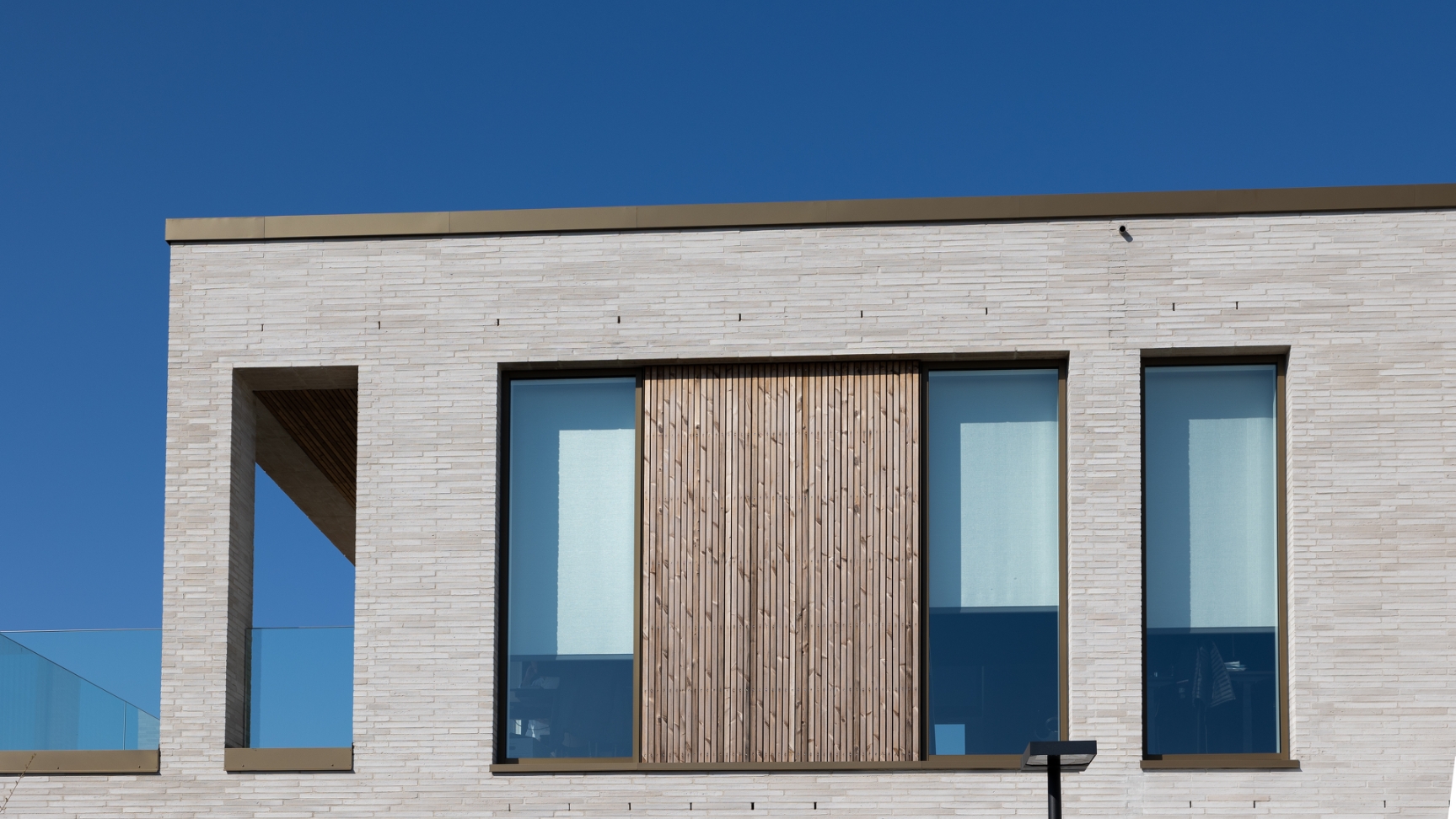
Brick Beams & Lintels for Cavity Walls: How to Reduce Cracking Around Openings
Brick-faced lintels and prefabricated brick beams for seamless openings and less cracking.
General Blogs Section
December 16, 2025
Cracking around windows and doors is one of the most common snagging issues on brickwork façades. Sometimes it’s hairline and cosmetic; sometimes it points to restraint, poor detailing, or moisture problems that will keep reappearing until the root cause is addressed.
A key point up front: no lintel “prevents” cracking on its own. Masonry moves. Buildings settle. Site conditions vary. What a good lintel solution can do is remove several of the common triggers around openings by providing predictable support, clean integration with the surrounding brickwork, and the right interfaces for moisture and thermal performance.
This guide explains how to specify and detail brick-faced lintels (brick soffit lintels) and brick beams in a way that supports a seamless façade finish and helps reduce cracking risk around openings—with practical, UK-relevant considerations for designers and contractors.
This guide explains how to specify and detail brick-faced lintels (brick soffit lintels) and brick beams. For a broader comparison of brick beams and lintels, read our guide to choosing the right solution for your project.
Why cracks form around openings
Openings interrupt the normal load path of masonry. They create corners where stresses concentrate and where movement is most likely to “show” first. Typical contributors include:
Differential movement and settlement: small movements in foundations or structure often express at opening corners.
Thermal and moisture movement: brickwork expands and contracts; if it’s restrained, the weakest points (often openings) crack.
Inadequate movement strategy: if movement isn’t accommodated, it will relieve itself wherever it can.
Uneven load transfer at the head: under-specification, twist, point bearing, poor bearing surfaces, or patchy workmanship can concentrate load.
Moisture and freeze–thaw exposure: trapped water at the head detail can accelerate deterioration and create recurring defects.
Sequencing and workmanship: mortar voids, cavity bridging, debris on trays, poor joint compaction, and inconsistent support all increase risk.
The opening head detail is a system, not a single product: lintel/beam + cavity tray/DPC + weeps + insulation continuity + frame fixing/restraint + workmanship.
What a cavity wall lintel must do
In UK cavity wall construction, the head detail needs to satisfy more than structural support. Your lintel solution should coordinate:
Structural performance Carry the masonry above the opening and any relevant loads (as designed).
Moisture management Work with cavity trays/DPCs and weeps so water drains to the outer leaf rather than tracking inward.
Thermal continuity Limit cold bridging at the head and reveals, supporting the building’s overall thermal target.
Durability and exposure Use suitable materials and corrosion resistance for the building’s environment (especially in harsh exposure zones).
Aesthetics Maintain coursing lines and soffit appearance where the elevation demands it.
What are brick-faced lintels and brick soffit lintels?
A brick-faced lintel (often described as a brick soffit lintel) is designed so the visible underside of the lintel reads as brickwork. This is especially useful on elevations where a standard steel lintel return or a visible material change would undermine the design intent.
There are different engineering approaches in the market. Some systems use a structural core with a brick finish; others use prefabricated brick-based construction reinforced as required. The common goal is the same: a structurally sound opening head that visually integrates with the surrounding masonry.
Why brick-faced lintels can help reduce cracking risk at openings
Used correctly, they can contribute to fewer defects because they:
Integrate more naturally with brickwork coursing and geometry, avoiding awkward transitions at the soffit line.
Provide controlled, repeatable units (often prefabricated) with consistent alignment and finish.
Support a cleaner interface at the opening, helping designers detail the head with fewer “make-do” compromises.
Many high-quality systems retain a very high proportion of real brick in the visible element, which helps maintain a consistent façade appearance and avoids the visual mismatch that can draw attention to small imperfections around openings.
When brick beams are the better choice
A brick beam is often used where you want the opening head to be a deliberate architectural feature or where spans and façade expectations are more demanding. For projects involving large openings, our dedicated guide explores prefabricated solutions in more detail.Typical use cases include:
Feature elevations where the soffit is highly visible and a “standard lintel look” isn’t acceptable.
Large glazed openings where long head details amplify visual discontinuities.
Deep reveals and crisp detailing where returns, mitres, or bespoke shapes are required.
Extensions and matching works where consistent brick appearance is critical.
Designs aiming for a cleaner façade language with fewer visible interruptions at openings.
Brick beams can also be helpful when you want the opening detail to be engineered and coordinated early—rather than left to site improvisation.
Specification: what to decide early (and why it matters)
If you want fewer cracks and fewer call-backs, these decisions shouldn’t be left until “lintels are ordered.”
1) Confirm span, opening geometry, and loading assumptions
Confirm structural opening sizes and lintel span requirements early.
Identify what the lintel supports: outer leaf only, additional loads, or complex conditions.
Flag non-standard loads or unusual arrangements for engineering input.
2) Confirm the wall build-up
Brick type, bond, coursing strategy.
Cavity width and insulation position.
Closers, ties, and fire-stopping coordination (where relevant).
3) Choose the right lintel family
Pick a solution that matches the design intent:
Standard cavity lintels (including insulated options) for straightforward details.
Brick-faced lintels for seamless soffits and façade continuity.
Brick beams for feature requirements, bespoke geometry, or specific architectural outcomes.
4) Detail moisture management at the head
A surprising number of “lintel defects” are actually drainage defects. Ensure:
Cavity tray/DPC is correctly positioned and lapped.
Stop-ends are used where required.
Weeps are provided and kept clear.
The cavity remains clear of mortar droppings and debris.
5) Manage thermal continuity (don’t create a cold bridge)
If thermal performance matters (and it usually does), avoid leaving the head detail as an uninsulated “gap” in the envelope. Coordinate:
Lintel selection (including insulated variants where appropriate).
Reveal insulation strategies and closers.
Window position relative to insulation line.
6) Plan movement and restraint—don’t let the opening “take the strain”
A lintel helps support masonry, but it does not replace a sensible movement strategy. Coordinate:
Movement joints where required for the building form and exposure.
Restraint conditions, including frame fixing and closers, so brickwork isn’t unintentionally “locked up.”
Interfaces with steelwork, concrete frames, or differing materials that may move differently.
Detailing around openings: practical approaches that reduce snagging
Keep support consistent and predictable
Cracks often trace back to “odd” load paths—point loads, uneven bedding, or twisting at the head. Good practice includes:
Ensuring the lintel/beam is installed level and aligned.
Avoiding conditions that could twist the lintel during installation.
Following manufacturer guidance on bearings, packing, and installation sequence.
Protect the cavity and keep drainage paths open
When cavities are bridged, water doesn’t behave. It tracks across mortar snots, debris, or poorly finished trays and shows up as staining and deterioration. Keep the cavity clean, and treat drainage as non-negotiable workmanship.
Coordinate brickwork appearance at the soffit
A key SEO and design driver for brick soffit lintels is appearance. If you want the soffit to read as continuous brickwork:
Confirm brick type, colour, bond, and coursing alignment early.
Where special detailing is required (returns, mitres, soldier courses, skewed heads), treat it as a designed element—not a site workaround.
Don’t ignore the reveal and frame interface
The head detail can be perfect, but the reveal can still crack if restraint is wrong or if there’s a poor interface between the frame and masonry. Coordinate:
Frame fixing strategy.
Closers and sealant joints.
Tolerances and movement allowances at the perimeter.
Installation pitfalls that commonly lead to cracking (and how to avoid them)
Assuming “any lintel will do.” Lintels are engineered products. Use the correct type, for the correct application, with the correct installation method.
Poor bearing and packing. Uneven bearing surfaces or incorrect packing can concentrate load and create cracks that radiate from corners.
Twist or misalignment during install. A lintel that’s not level or is forced into position can behave unpredictably once loaded.
Cavity trays and weeps treated as optional. They’re not. A dry, draining head detail stays durable and stable.
Cavity bridging with mortar droppings. It only takes a few bridges to create tracking paths that lead to staining, spalling, and recurring defects.
Late design changes to openings. Small changes can create awkward support conditions, inconsistent coursing, or rushed on-site solutions.
Why prefabrication can be a big advantage on opening details
Where a project demands a clean façade, prefabricated brick-faced lintels and brick beams can add value because:
geometry and alignment are controlled off-site,
the brick finish is coordinated as part of the engineered unit,
site time is reduced and quality becomes more repeatable,
complex shapes and consistent soffits are easier to achieve.
In short: less improvisation at the opening head usually means fewer defects later.
How we help: technical guidance and supplier-backed solutions
We work with proven specialist suppliers to provide brick beams and brick-faced lintels that support seamless façade design. As the UK’s exclusive supplier of Randers Tegl products, we can also support consistent façade integration—aligning brick finish, coursing and soffit appearance with specified waterstruck bricks or other facing brickwork.. We can assist with:
selecting the appropriate lintel/beam approach for your wall build-up and intent,
coordinating brick finish, coursing, and soffit appearance,
reviewing opening details to reduce snagging risk,
supporting design teams and contractors with product guidance and buildability input.
If your project has feature elevations, large openings, or brickwork where finish quality matters, involve us early—opening details are far easier to get right on paper than on scaffolding.
FAQs
What’s the difference between a brick-faced lintel and a brick beam? A brick-faced lintel is typically used for seamless brick soffits over openings, while brick beams are often used for more feature-led detailing, bespoke geometry, or where the opening head is a stronger architectural element.
Will brick-faced lintels stop cracks above windows? They can reduce the risk by improving support consistency and integration with brickwork—but cracking control still depends on movement planning, moisture detailing, restraint, and workmanship.
Do I still need cavity trays and weeps with brick soffit lintels? Yes. Drainage detailing remains essential regardless of lintel type.
Are brick-faced lintels suitable for all exposures? Exposure should always be considered during specification. Choose products and materials suitable for the environment and follow manufacturer guidance.
What’s the best way to avoid snagging around openings? Treat the head detail as a system, coordinate movement and restraint, detail drainage properly, and use engineered solutions installed to guidance.